
How to Search Dauphin County Court Records
Two free systems handle most searches. The Prothonotary runs a public civil case search for Court of Common Pleas civil matters, with current records from November 1, 2001 to the present. The statewide Unified Judicial System (UJS) portal covers criminal dockets, Magisterial District Court cases, traffic citations, and appeals. Estate and marriage records sit with a separate office and its own search tool.
Before you begin, collect a docket number, a full name, or a rough filing date. Dauphin County is county code 22 in Common Pleas dockets and district 12 in magisterial dockets. The county's civil case search is the starting point for civil and divorce matters.
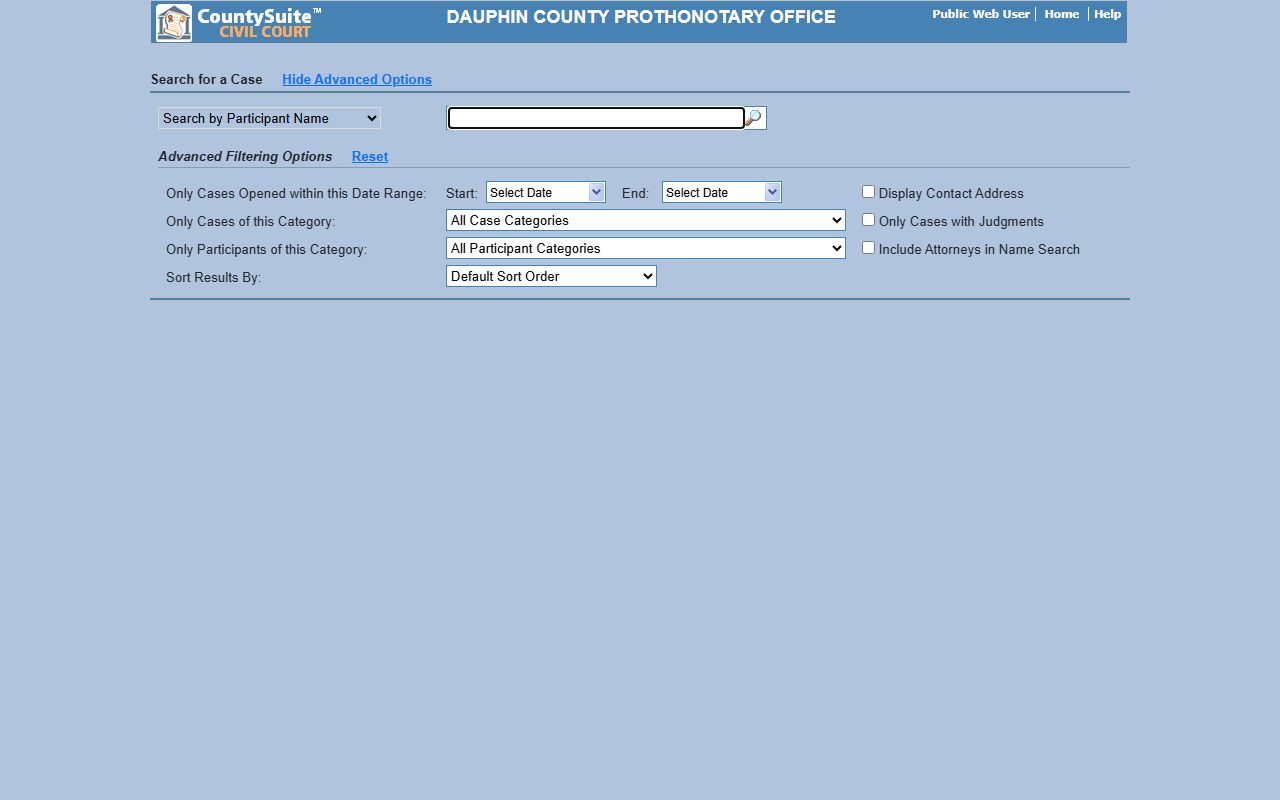
That CountySuite search lets you enter a name and open public civil dockets without a login.
- Decide the record type: civil, criminal, traffic, or estate.
- For civil Common Pleas cases, open the Prothonotary Searchable Civil Records page.
- For criminal, magisterial, or appellate dockets, use the UJS Web Portal case search.
- Search by docket number, or by participant name plus Dauphin County.
- Open the docket sheet and request a certified copy from the clerk if you need an official record.
Dauphin County Court Records Search Fields
The UJS case search offers many search modes. For Dauphin County records, a few fields do most of the work. The table lists the ones you will use most, with format notes pulled from the portal.
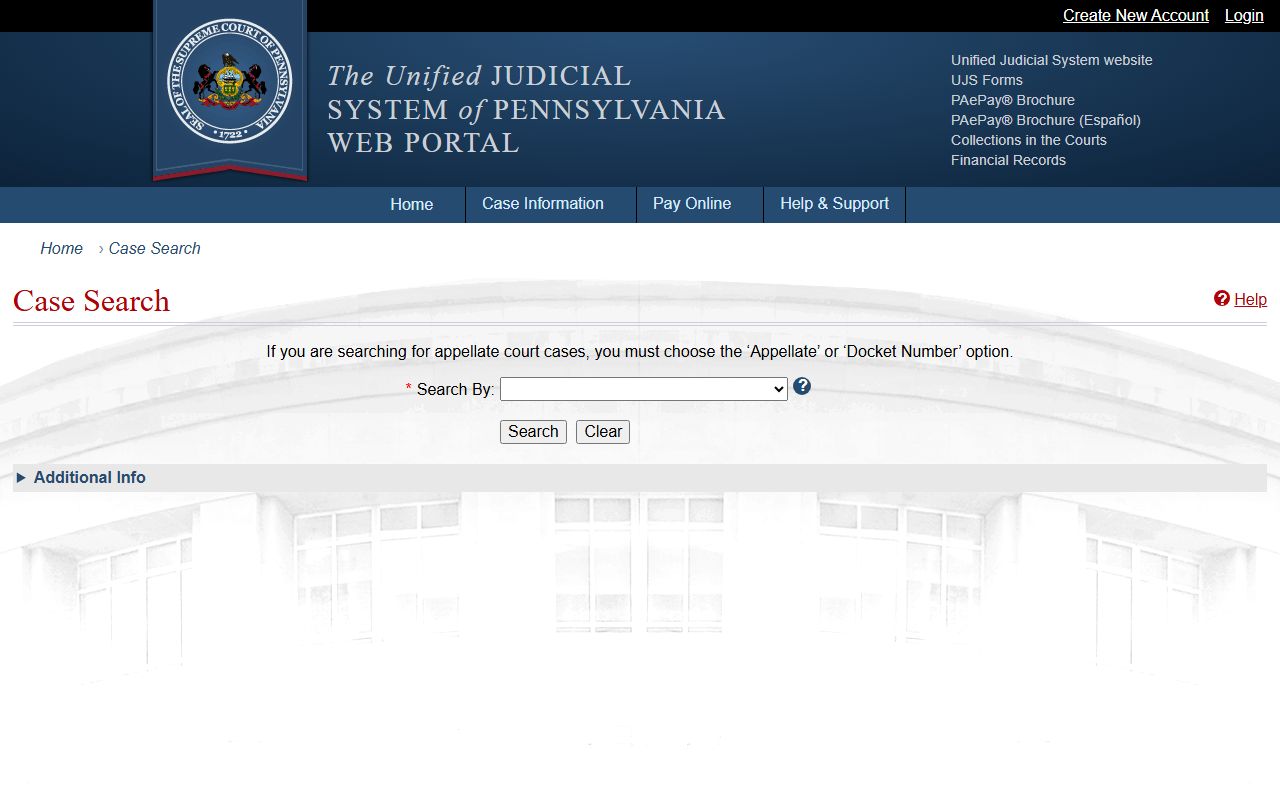
The UJS case search form is shown above; the table below breaks down its key fields.
| Field Label | Type | Required | Notes / Format |
|---|---|---|---|
| Search By | Dropdown | Yes | Docket Number, Participant Name, Citation Number, OTN, and more. |
| Docket Number | Text | When selected | Common Pleas CP-22-CR; magisterial MJ-12. |
| Participant Name | Text | When selected | Last and first name. |
| County | Dropdown | Conditional | Choose Dauphin. |
| Date Filed | Date | Conditional | mm/dd/yyyy; 180-day max range. |
| Docket Type | Dropdown | Optional | Criminal, civil, traffic, landlord-tenant, and others. |
| Case Status | Dropdown | Optional | Active, Closed, Inactive, Adjudicated. |
Types of Dauphin County Court Records
Different offices keep different records, and the case type tells you where to look. Civil and divorce matters go to the Prothonotary. Criminal and juvenile cases go to the Clerk of Courts. Estates and marriages go to the Register of Wills. Magisterial courts handle traffic and small claims.
The Pennsylvania court system page explains how these levels fit together.
The main Dauphin County court record types are:
- Civil records - lawsuits, judgments, arbitration, name changes, and landlord-tenant cases.
- Criminal records - complaints, pleas, sentences, and summary appeals.
- Family records - support, custody, divorce, and protection-from-abuse matters.
- Estate and Orphans' Court records - wills, letters, guardianships, and adoptions.
- Magisterial records - traffic citations, small claims, and preliminary hearings.
What Dauphin County Court Records Show
A docket sheet is the public face of a Dauphin County court record. It opens with case header data, then lists each filing and event in date order. Criminal dockets add charge, bail, and sentence fields. The inventory below shows the fields you will read on a typical record.
| Field | What It Shows |
|---|---|
| Docket Number | The case ID, such as CP-22-CR for a Dauphin criminal case. |
| Court and County | The court level, court office, and Dauphin County. |
| Filing Date | When the case opened. |
| Parties | Plaintiff, defendant, petitioner, respondent, and attorneys. |
| Charges / Cause | Offense, statute, and grade, or the civil claim. |
| Docket Entries | Motions, orders, hearings, pleas, and continuances. |
| Disposition | The outcome of each charge or claim. |
| Financial | Costs, fines, restitution, and payment plans. |
Note: The UJS warns that recent filings may not appear right away and that some civil Common Pleas data does not display in the portal.
Civil Records and the Prothonotary
The Prothonotary is Pennsylvania's civil clerk for the Court of Common Pleas. In Dauphin County, the office records arbitration, argument court, civil trials, name changes, divorce certificates, and landlord-tenant disputes. Online civil coverage is split. Current records run from November 1, 2001 to the present in the public search. Older material lives in legacy indexes, including a Misc. and Ejectment Index for 1785 to 1973 and a Suits Index for 1992 to 2001.
The office is moving to a new case management system, so it warns that some records may not appear online yet. For e-filing or a logged-in civil search, the county runs a separate civil court filing portal.
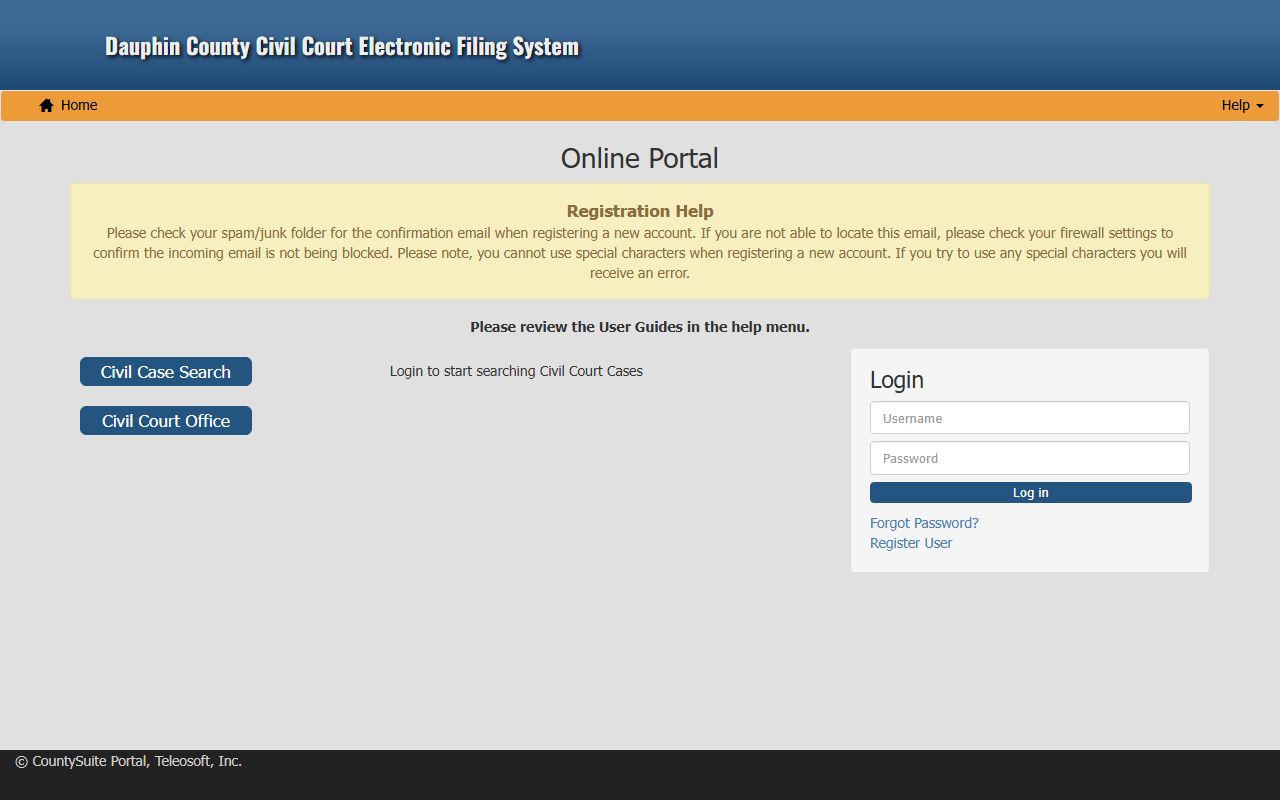
That portal needs a login, and the registration page warns that special characters in your sign-up details cause an error. Full details sit on the Prothonotary page.
Criminal Records and the Clerk of Courts
Criminal court records run through the Clerk of Courts, which keeps criminal and juvenile records for the Court of Common Pleas. The office assesses costs and fines, processes bail and prison commitments, and handles motions, summary appeals, and appeals to the state courts. Its files start where a Magisterial District Court binds a case over for trial.
For public viewing, criminal dockets show in the UJS portal. For certified criminal copies, contact the Clerk of Courts directly. Arrest and booking detail sits on the arrest records page.
One quirk worth noting: the same office also licenses private detectives in the county. Its core job, though, stays with criminal and juvenile case files, bail, and the costs and fines that ride along with a sentence. Cases reach the office two ways. Most arrive after a Magisterial District Court binds a charge over for trial. Others come straight from a courtroom disposition once a judge rules.
Key Terms in Dauphin County Court Records
Court records lean on terms that are easy to misread. A short glossary helps you make sense of a docket before you call an office or order a copy.
- Prothonotary
- The civil clerk who files and keeps Common Pleas civil records.
- Clerk of Courts
- The clerk who keeps criminal and juvenile records for Common Pleas.
- Docket
- The dated list of every filing and event in a case.
- Disposition
- The current or final result of a charge or claim.
- OTN
- The offense tracking number tied to a Pennsylvania criminal case.
Public Access Framework for Dauphin County Court Records
Court case records follow the Unified Judicial System's public-access policy, not the county Right-to-Know process. The UJS public record policies page posts the case-records policy and the electronic access policy that govern what shows online.
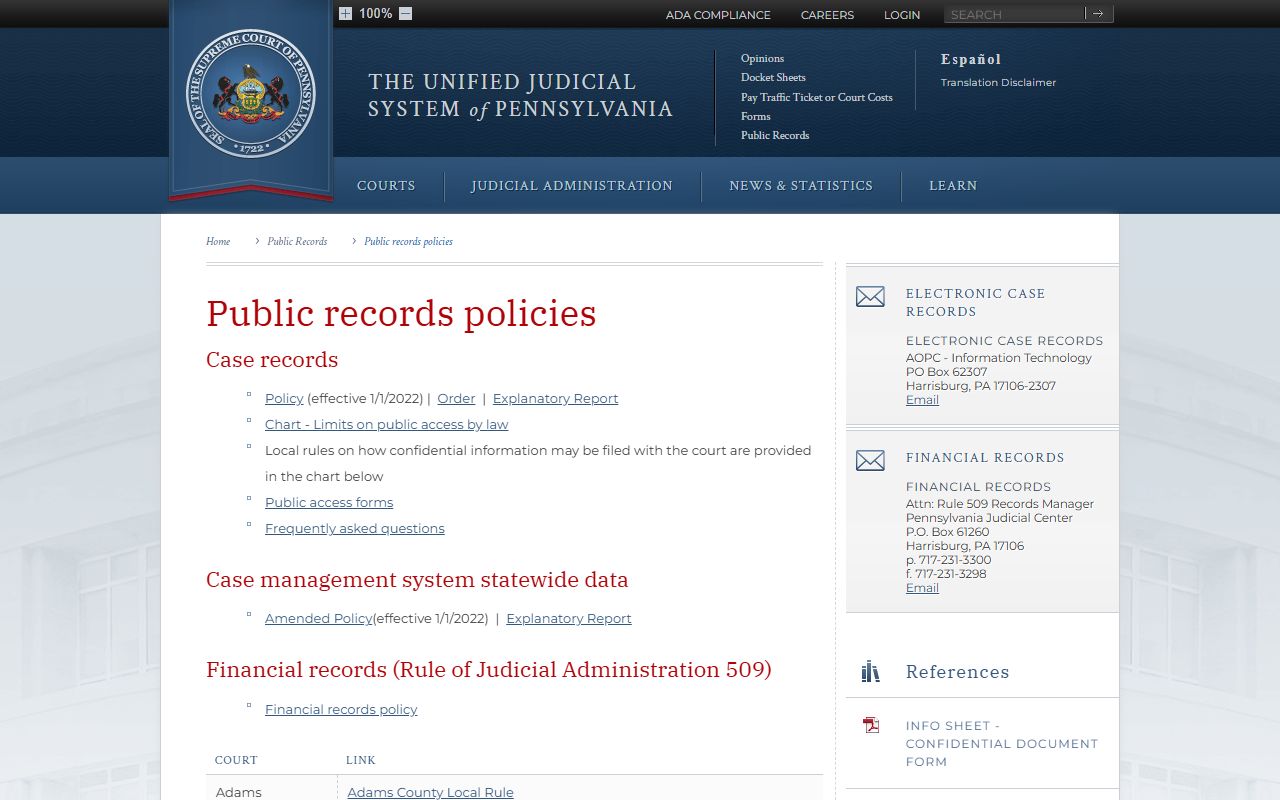
Anyone can view a public docket. There is no need to show ID or give a reason. Still, the policy requires that confidential information and documents be filed on separate forms, and it keeps certain data off the public record.
Note: A UJS docket sheet is a court record, not a criminal-history background check, which the state handles separately through the Pennsylvania State Police.
Records That Are Sealed or Confidential in Dauphin County
Some Dauphin County court records are closed to the public. Juvenile cases are confidential under the Juvenile Act. Expunged records under 18 Pa.C.S. § 9122 drop out of search results. Limited-access cases under Act 5 of 2016 cannot be viewed or paid for online. Sealed search warrants and grand jury matters stay hidden until a court unseals them.
To view a sealed record, you generally need a court order or a recognized legal interest, filed in the court that holds the file. The Self Help Center and the Clerk of Courts stock the petitions and confidential-information forms these filings require.
In-Person and Certified Court Record Requests
Screenshots are not official. For a record you can use in court or with an agency, ask the right clerk for a certified copy. Civil certified copies come from the Prothonotary. Criminal copies come from the Clerk of Courts. Estate and marriage copies come from the Register of Wills. The main counter is at the courthouse in Harrisburg.
Bring the docket number if you have it. That one detail speeds up the request and cuts the search fee an office may charge to locate a file by name alone. Plan for a copy fee and a separate certification fee. Most offices take a check, money order, or card, and some do not accept cash, so confirm payment rules before you go.
Dauphin County Prothonotary
101 Market Street, Room 101
Harrisburg, PA 17101
(717) 780-6520
Mon-Fri 8:00 a.m. to 4:30 p.m.
Older and Historical Court Records
Dauphin County holds deep historical records. Estate and Orphans' Court files reach back to the late 1700s. Marriage licenses run from 1885. Civil index material exists from 1785. These older records may not appear in the modern online search and often need a legacy index lookup or an office visit.
The Prothonotary posts separate legacy links for this older civil material. A Misc. and Ejectment Index covers 1785 through mid-1973 and then 1973 through 1991. A Suits Index handles name and docket searches from 1992 through October 2001. If a case predates the current system, those indexes are where the trail starts. For anything you cannot find online, the office counter in Harrisburg can pull the paper file.